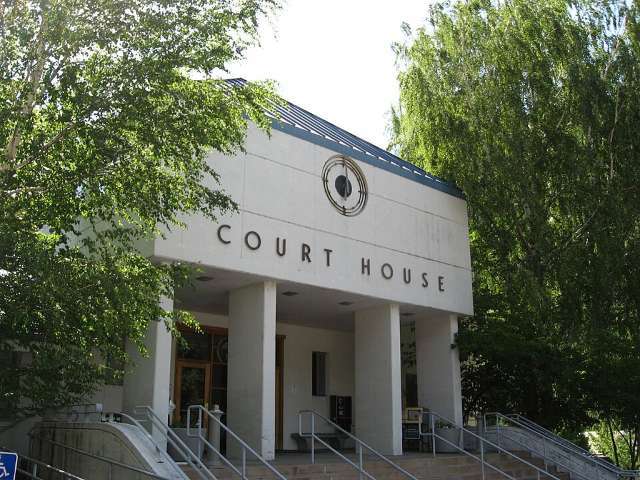
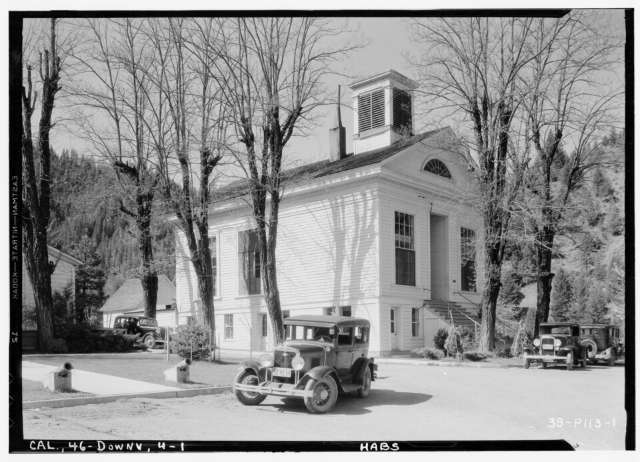
Downieville was founded in late 1849 and was first called The Forks, because it sits where the Downie River meets the North Fork of the Yuba River. It was then named for Major William Downie. By 1851 it had more than 5,000 people, and it is still the county seat of Sierra County.
The county built a courthouse in 1854. In 1885 it built a wooden gallows designed to be taken apart and stored. It was used once, on November 27, 1885, for a 20-year-old man convicted of murdering a dairyman at Webber Lake. Changes in state law in 1891 ended local executions in California.
The gallows was kept in the courthouse attic until it was found in 1927, then rebuilt beside the courthouse. The courthouse was destroyed by fire in 1947, but the gallows survived. It was restored in 1988 and is California Historical Landmark No. 971 and on the National Register of Historic Places (1990).
Downieville's gold rush history also has a darker day. On July 5, 1851, a mob hanged Josefa Segovia, a Californio woman, from the Jersey Bridge after a mock trial. She was accused of stabbing a miner named Frederick Cannon. She is described as the only known woman lynched in California. Accounts of what led up to it differ, and some historians doubt she was the killer. A marker on Main Street, dedicated in 2024, remembers her.